
In the ever-evolving landscape of personal finance, one of the most powerful tools at your disposal for securing a comfortable retirement and simultaneously reducing your tax burden is your 401(k). As we look ahead to 2026, understanding how to maximize 401k 2026 contributions is not just a smart financial move; it’s an imperative strategy for wealth accumulation and tax efficiency. This comprehensive guide will delve deep into the nuances of 401(k) plans, providing you with actionable insights and strategies to ensure you’re making the most of this invaluable retirement vehicle.
The allure of the 401(k) lies in its dual benefits: tax-deferred growth (or tax-free withdrawals with a Roth 401(k)) and the potential for employer matching contributions, which are essentially free money. For 2026, staying informed about the latest contribution limits and rules is crucial. While specific figures for 2026 are often announced closer to the end of 2025, we can project based on historical trends and provide a robust framework for your planning.
Anúncios
Understanding the Basics: What is a 401(k)?
Before we dive into maximization strategies, let’s briefly recap what a 401(k) is. A 401(k) is an employer-sponsored retirement savings plan that allows employees to invest a portion of their paycheck before taxes are withheld. This pre-tax contribution reduces your current taxable income, leading to immediate tax savings. The money then grows tax-deferred until retirement, at which point withdrawals are taxed as ordinary income. Some employers also offer a Roth 401(k) option, where contributions are made with after-tax dollars, but qualified withdrawals in retirement are tax-free.
Key Benefits of a 401(k)
- Tax Advantages: Immediate tax deduction for traditional 401(k) contributions, or tax-free withdrawals in retirement for Roth 401(k).
- Employer Match: Many employers offer to match a percentage of your contributions, significantly boosting your savings.
- Automatic Savings: Contributions are deducted directly from your paycheck, promoting consistent saving habits.
- Compounding Growth: Your investments grow over time, and earnings on those investments also earn returns, accelerating your wealth accumulation.
Navigating 2026 401(k) Contribution Limits
The cornerstone of maximizing your 401(k) is understanding and hitting the annual contribution limits. While the exact figures for 2026 will be announced later, we can anticipate them based on inflation adjustments. For reference, the 2023 and 2024 limits saw significant increases. It’s reasonable to expect a similar upward trend for 2026. The primary limits to be aware of include:
Anúncios
- Employee Contribution Limit: This is the maximum amount you, as an employee, can contribute from your salary.
- Catch-Up Contribution Limit: If you are aged 50 or over, the IRS allows you to contribute an additional amount above the standard employee limit. This is a crucial provision for those nearing retirement who want to boost their savings.
- Total Contribution Limit (Employee + Employer): This is the aggregate limit for all contributions to your 401(k) in a year, including your contributions, employer matching contributions, and any profit-sharing contributions.
Pro-Tip: Always check the IRS website or consult with your plan administrator for the most up-to-date contribution limits for 2026 as soon as they are released. Planning ahead allows you to adjust your payroll deductions early in the year.
Strategies to Maximize Your 401(k) Contributions in 2026
Simply knowing the limits isn’t enough; you need a strategic approach to actually reach them. Here are several effective strategies to help you maximize 401k 2026 contributions:
1. Contribute Enough to Get the Full Employer Match
This is arguably the most important step. If your employer offers a 401(k) match, contributing at least enough to receive the full match is non-negotiable. It’s an immediate, guaranteed return on your investment, often ranging from 50% to 100% on a portion of your contributions. Failing to do so is leaving free money on the table.
2. Front-Load Your Contributions (If Possible)
Some financial advisors suggest front-loading your contributions, meaning you contribute a higher percentage of your salary earlier in the year. This allows your money more time in the market to grow through compounding. However, be mindful of employer matching rules. Some companies only match contributions on a per-pay-period basis, meaning if you hit the annual maximum too early, you might miss out on matching contributions for later pay periods. Understand your plan’s specific matching schedule.
3. Increase Your Contribution Rate Annually
Even a small increase in your contribution rate each year can have a significant impact over time. Consider implementing an ‘auto-increase’ feature if your plan offers it, where your contribution rate automatically goes up by 1% or 2% each year. This is often tied to salary increases, so you might not even notice the difference in your take-home pay.
4. Utilize Catch-Up Contributions (Age 50+)
For those aged 50 and above, catch-up contributions are a golden opportunity to accelerate retirement savings. If you’re eligible, make it a priority to contribute the maximum catch-up amount in addition to the standard employee limit. This can significantly boost your nest egg in the years leading up to retirement.
5. Reinvest Your Tax Savings
When you contribute to a traditional 401(k), you reduce your taxable income, which can lead to a larger tax refund or a lower tax bill. Instead of spending this extra money, consider reinvesting it. You could direct it into a Roth IRA, a taxable brokerage account, or even increase your 401(k) contributions for the following year. This strategy amplifies your overall savings.
6. Understand and Utilize Both Traditional and Roth 401(k) Options
Many employers now offer both traditional and Roth 401(k) options. The choice depends on your current and projected future tax situation. If you expect to be in a higher tax bracket in retirement, a Roth 401(k) might be more advantageous, as withdrawals are tax-free. If you’re in a high tax bracket now and expect to be in a lower one in retirement, a traditional 401(k) offers immediate tax relief. You can also diversify by contributing to both, balancing your tax exposure in retirement.
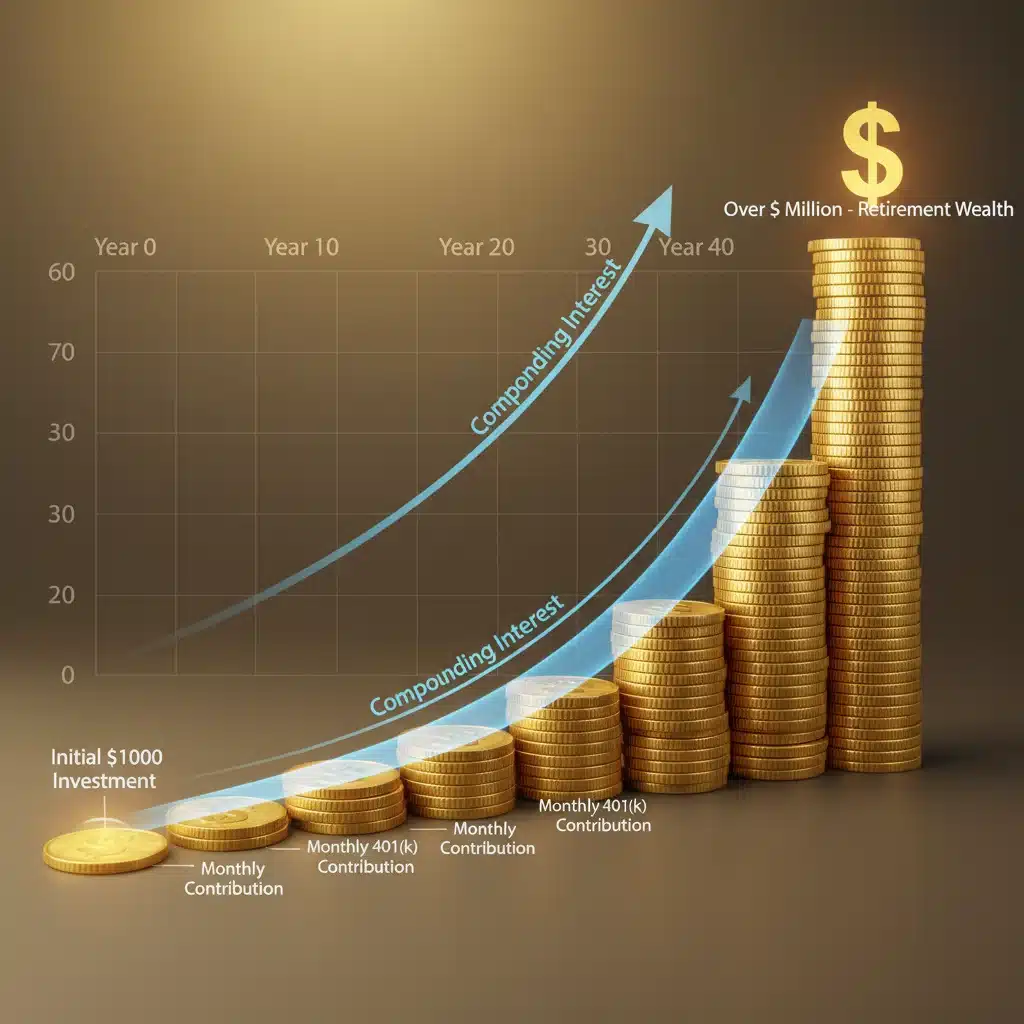
The Power of Compounding: Why Early and Consistent Contributions Matter
The concept of compounding interest is often referred to as the ‘eighth wonder of the world,’ and for good reason. It’s the process where the earnings on your investments also earn returns, leading to exponential growth over time. The earlier you start and the more consistently you contribute to your 401(k), the more powerful compounding becomes.
Consider two individuals, Alice and Bob. Alice starts contributing $500 a month to her 401(k) at age 25. Bob starts at age 35, also contributing $500 a month. Assuming an average annual return of 7%, by age 65, Alice will have significantly more saved than Bob, even though they both contributed the same monthly amount for different durations. This demonstrates the immense benefit of starting early and consistently contributing to maximize 401k 2026 potential.
Illustrative Example of Compounding
- Alice (starts at 25): Contributes for 40 years. Total contributions: $240,000. Estimated value at 65: Over $1.2 million.
- Bob (starts at 35): Contributes for 30 years. Total contributions: $180,000. Estimated value at 65: Around $600,000.
This stark difference highlights why maximizing your contributions in 2026, and every year, is so critical, especially for younger investors.
Advanced Strategies for 401(k) Optimization
Beyond the basic strategies, there are several advanced tactics you can employ to further optimize your 401(k) and broader retirement planning.
1. The Mega Backdoor Roth (If Your Plan Allows)
This advanced strategy allows high-income earners to contribute significantly more to a Roth account than the standard Roth IRA limits. It involves contributing after-tax money to your 401(k) (beyond the pre-tax or Roth 401(k) limits, but within the total contribution limit) and then converting it to a Roth IRA. This is a complex strategy and requires your 401(k) plan to allow after-tax contributions and in-service distributions or rollovers. Consult a financial advisor to see if this is viable for your situation and plan.
2. Diversification Within Your 401(k)
While maximizing contributions is crucial, the growth of your 401(k) also depends on your investment choices. Ensure your portfolio is well-diversified across different asset classes (stocks, bonds, real estate, etc.) to mitigate risk and optimize returns. Regularly review and rebalance your investments to align with your risk tolerance and financial goals. Most 401(k) plans offer a range of mutual funds, index funds, and target-date funds. Choose wisely.

3. Understanding the Impact of Fees
Fees can erode your investment returns over time. Pay attention to the expense ratios of the funds within your 401(k) plan. Opt for low-cost index funds or ETFs when available. Even a small difference in expense ratios can translate into tens of thousands of dollars over a 30-year investment horizon. Your plan administrator should provide detailed information on fees.
4. Consider a Financial Advisor
For complex financial situations or if you feel overwhelmed by investment decisions, a qualified financial advisor can provide personalized guidance. They can help you craft a holistic retirement plan, optimize your 401(k) contributions, and integrate it with other savings vehicles like IRAs, HSAs, and taxable accounts. They can also help you navigate potential tax implications and plan for various life events.
Integrating Your 401(k) with Other Retirement Accounts
While your 401(k) is a powerful tool, it’s often just one piece of a larger retirement puzzle. Integrating it with other retirement accounts can create a more robust and flexible financial future.
Individual Retirement Accounts (IRAs)
Both Traditional and Roth IRAs offer additional avenues for tax-advantaged savings. Even if you contribute to a 401(k), you might still be eligible to contribute to an IRA, depending on your income and whether you’re covered by an employer-sponsored retirement plan. IRAs often offer a wider range of investment options compared to 401(k)s.
Health Savings Accounts (HSAs)
If you’re enrolled in a high-deductible health plan (HDHP), an HSA can be an incredibly powerful triple-tax-advantaged savings vehicle. Contributions are tax-deductible, growth is tax-free, and qualified withdrawals for medical expenses are also tax-free. For those who can afford to pay for medical expenses out-of-pocket, an HSA can effectively function as an additional retirement account, especially in later years when medical costs tend to rise.
Common Pitfalls to Avoid When Maximizing Your 401(k)
Even with the best intentions, some common mistakes can derail your efforts to maximize 401k 2026 contributions and growth.
1. Not Contributing Enough to Get the Full Employer Match
As mentioned earlier, this is the biggest mistake. It’s essentially turning down free money. Always prioritize contributing at least enough to get the full match.
2. Cashing Out Your 401(k) When Changing Jobs
When you leave a job, you have several options for your 401(k): leave it with the old employer, roll it over to your new employer’s plan, roll it over to an IRA, or cash it out. Cashing it out should almost always be avoided. You’ll likely face income taxes and a 10% early withdrawal penalty (if under 59½), significantly depleting your retirement savings.
3. Taking a 401(k) Loan
While some plans allow 401(k) loans, it’s generally not advisable. You’re borrowing from your future self, and if you leave your job, you often have to repay the loan in full very quickly. If you can’t, it becomes a taxable distribution subject to penalties.
4. Being Too Conservative or Too Aggressive with Investments
Your investment strategy within your 401(k) should align with your time horizon and risk tolerance. Being too conservative, especially when young, means missing out on potential growth. Being too aggressive when nearing retirement can expose you to unnecessary risk. Regularly review and adjust your asset allocation.
5. Forgetting to Update Beneficiaries
Life changes – marriage, divorce, birth of children. It’s crucial to regularly review and update the beneficiaries on your 401(k) to ensure your assets are distributed according to your wishes. This often supersedes your will.
The Tax Implications of Maximizing Your 401(k)
One of the most compelling reasons to maximize 401k 2026 contributions is the significant tax advantage. For traditional 401(k) contributions, every dollar you contribute reduces your taxable income for the current year. For example, if you contribute $20,000 to your 401(k) and are in the 24% federal tax bracket, you could save $4,800 in federal taxes for that year. This is a substantial immediate benefit.
Furthermore, your investments grow tax-deferred. This means you don’t pay taxes on capital gains, dividends, or interest until you withdraw the money in retirement. This allows your money to compound more efficiently without the annual drag of taxes.
For Roth 401(k) contributions, while you don’t get an upfront tax deduction, the benefit comes in retirement. Qualified withdrawals are entirely tax-free. This can be incredibly valuable, especially if you anticipate being in a higher tax bracket in retirement or if tax rates increase in the future.
Future Tax Planning
Maximizing contributions to both traditional and Roth accounts (if available and suitable for your income) can provide flexibility in retirement. You’ll have a mix of taxable and tax-free income sources, allowing you to strategically manage your tax burden in your golden years.
Conclusion: Your Path to a Secure 2026 and Beyond
As you plan for 2026 and the years to come, making the most of your 401(k) is a fundamental pillar of sound financial planning. By understanding the contribution limits, strategically increasing your contributions, taking advantage of employer matches, and making informed investment decisions, you can significantly accelerate your journey towards a comfortable and financially secure retirement.
Remember, the power of compounding is on your side, but it needs fuel in the form of consistent contributions. Don’t leave free money or potential tax savings on the table. Start planning now to maximize 401k 2026 contributions and set yourself up for long-term financial success. Regularly review your plan, stay informed about changes in contribution limits and tax laws, and don’t hesitate to seek professional advice when needed. Your future self will thank you.