Optimize Your Investment Portfolio: 3-Month Rebalancing Strategy for 2026

Anúncios
Optimizing Your Investment Portfolio for 2026: A 3-Month Rebalancing Strategy
In the dynamic world of finance, maintaining a healthy and prosperous investment portfolio is not a ‘set it and forget it’ endeavor. Market conditions, economic forecasts, and even your personal financial goals are constantly evolving, necessitating a proactive approach to your investments. As we look towards 2026, the importance of a robust portfolio rebalancing strategy becomes even more pronounced. This comprehensive guide will delve into the intricacies of a 3-month rebalancing strategy, offering you the tools and insights to not only protect your capital but also to capitalize on emerging opportunities.
Anúncios
Many investors, both novice and experienced, often fall into the trap of letting their portfolios drift. What begins as a carefully constructed allocation can, over time, become skewed due to differential asset performance. For instance, a booming stock market might cause your equity allocation to swell beyond its initial target, inadvertently increasing your risk exposure. Conversely, a sluggish sector might shrink, leading to missed growth opportunities. This is where the power of a disciplined portfolio rebalancing strategy comes into play, acting as a crucial mechanism to realign your investments with your long-term objectives and risk tolerance.
Our focus today is on a 3-month rebalancing cycle. While some prefer annual or semi-annual reviews, a quarterly approach offers a sweet spot between being too frequent (which can incur excessive transaction costs and emotional fatigue) and too infrequent (which can allow significant deviations from your target allocation). This regular, yet manageable, rhythm allows you to adapt to market shifts more promptly, ensuring your portfolio remains optimized for the challenges and opportunities that 2026 will undoubtedly present. By the end of this article, you will have a clear understanding of how to implement this strategy, its benefits, and the potential pitfalls to avoid.
Anúncios
What is Portfolio Rebalancing Strategy?
At its core, a portfolio rebalancing strategy is the process of adjusting the weightings of assets in your investment portfolio. The goal is to bring your portfolio back to its original, desired asset allocation. Imagine you start with a portfolio designed to be 60% stocks and 40% bonds. Over time, due to market fluctuations, your stocks might perform exceptionally well, causing their proportion to rise to 70% of your total portfolio, while bonds might lag, falling to 30%. Rebalancing would involve selling some of your stocks and buying more bonds to restore the 60/40 allocation.
This seemingly simple act has profound implications for your investment journey. It’s not about trying to time the market or chase the latest hot trend. Instead, it’s about maintaining discipline and adhering to a pre-determined investment plan. This plan is typically based on your individual financial goals, time horizon, and, most importantly, your risk tolerance. Without a regular portfolio rebalancing strategy, your risk profile can inadvertently change, potentially exposing you to more volatility than you are comfortable with or missing out on diversification benefits.
There are generally two main approaches to rebalancing: time-based and threshold-based. Time-based rebalancing, which is the focus of our 3-month strategy, involves adjusting your portfolio at fixed intervals, regardless of market performance. This could be quarterly, semi-annually, or annually. The advantage here is its simplicity and consistency. You set a date, and you rebalance. Threshold-based rebalancing, on the other hand, involves adjusting your portfolio only when an asset class deviates by a certain percentage from its target allocation. For example, if your target for stocks is 60% and they exceed 65% or fall below 55%, you would rebalance. Both methods have their merits, but for a proactive and systematic approach, a time-based cycle like our 3-month portfolio rebalancing strategy is often preferred by those seeking regular oversight.
Understanding the fundamental concept of rebalancing is the first step towards mastering your investment journey. It’s a strategic tool that helps you stay true to your financial blueprint, regardless of the unpredictable twists and turns of the market. By consistently implementing a portfolio rebalancing strategy, you are essentially buying low and selling high, even if unconsciously, as you trim overperforming assets and bolster underperforming ones.
Why a 3-Month Portfolio Rebalancing Strategy for 2026?
The choice of a 3-month cycle for your portfolio rebalancing strategy is not arbitrary; it’s a carefully considered approach that offers several distinct advantages, particularly as we look ahead to the economic landscape of 2026. The financial markets are increasingly complex and interconnected, with global events, technological advancements, and shifting geopolitical dynamics capable of triggering rapid changes. A quarterly review allows for a more agile response compared to less frequent cycles.
Enhanced Risk Management
One of the primary reasons for a regular portfolio rebalancing strategy is risk management. Without rebalancing, your portfolio’s risk profile can drift significantly. If a particular asset class, say technology stocks, undergoes a substantial boom, its proportion in your portfolio will grow. While this might seem beneficial on the surface, it also means your portfolio is now more heavily concentrated in that single asset class, increasing your exposure to its specific risks. A sudden downturn in that sector could have a disproportionately negative impact on your overall wealth. A 3-month rebalancing ensures that such overconcentration is addressed relatively quickly, bringing your portfolio back to its intended risk level.
Disciplined Profit Taking and Value Investing
Regular rebalancing inherently encourages a ‘buy low, sell high’ mentality, even if it’s not explicitly market timing. When an asset class performs well, its weight in your portfolio increases. Rebalancing involves selling a portion of this overperforming asset to bring it back to its target. This is essentially taking profits. Conversely, when an asset class underperforms, its weight decreases. Rebalancing means buying more of this underperforming asset to restore its target weight. This aligns with value investing principles, as you are adding to assets that are relatively cheaper. A 3-month cycle allows you to execute this strategy more frequently, potentially capturing more of these opportunities over time.
Adaptability to Market Changes
The economic outlook for 2026 is filled with both promise and uncertainty. Inflation, interest rates, geopolitical tensions, and technological disruptions will all play a role in shaping market performance. A 3-month portfolio rebalancing strategy provides the flexibility to adapt to these shifts. If new economic data or a significant market event suggests a fundamental change in outlook, a quarterly review allows you to consider adjusting your target allocations more readily than an annual review would. It keeps you engaged with your investments without demanding constant, daily attention.
Reduced Emotional Investing
Emotional decision-making is one of the biggest enemies of successful investing. When markets are soaring, there’s a temptation to chase returns, and when they’re falling, panic can set in, leading to selling at a loss. A fixed 3-month rebalancing schedule removes much of this emotional element. It transforms investing into a systematic, rule-based process. You’re not reacting to daily headlines; you’re executing a pre-defined plan. This consistency is invaluable for long-term wealth creation and helps you avoid costly mistakes driven by fear or greed.
In essence, a 3-month portfolio rebalancing strategy is a powerful tool for maintaining control over your financial destiny. It’s about being proactive rather than reactive, disciplined rather than emotional, and strategically positioned for whatever the future of 2026 may hold.
Key Benefits of a 3-Month Portfolio Rebalancing Strategy
Implementing a 3-month portfolio rebalancing strategy offers a multitude of benefits that contribute to the long-term health and growth of your investments. While the act of rebalancing might seem counterintuitive – selling winners and buying losers – its advantages are firmly rooted in sound financial principles.
Consistent Risk Exposure
Perhaps the most critical benefit is ensuring your portfolio’s risk exposure remains consistent with your initial financial plan and risk tolerance. Without rebalancing, a booming stock market can lead to your equity allocation growing substantially, inadvertently increasing your portfolio’s overall risk. Conversely, if a conservative asset class like bonds performs poorly, their proportion might shrink, reducing your portfolio’s stability. A 3-month cycle acts as a regular checkpoint, preventing significant drift and keeping your risk profile aligned with your comfort level.
Capitalizing on Market Volatility
While often viewed negatively, market volatility can be an investor’s friend, especially with a disciplined portfolio rebalancing strategy. By regularly selling assets that have performed well (and thus have become overweighted) and buying assets that have performed poorly (and are now underweighted), you are effectively buying low and selling high. This systematic approach allows you to profit from the natural ebb and flow of the markets without needing to predict their movements. The 3-month interval is frequent enough to capture these opportunities more effectively than annual rebalancing, but not so frequent as to incur excessive transaction costs.
Improved Diversification
Diversification is a cornerstone of prudent investing, spreading your risk across various asset classes, industries, and geographies. However, over time, the performance of different assets can cause your diversification to erode. For example, if one sector skyrockets, it might dominate your portfolio, reducing the benefits of holding other assets. A 3-month portfolio rebalancing strategy ensures that you consistently maintain your desired diversification levels, protecting you from overexposure to any single investment and enhancing the stability of your returns.
Enhanced Returns Over the Long Term
While rebalancing might sometimes lead to slightly lower returns in a consistently rising market (by selling some of your winners), historical data and academic studies often show that a disciplined rebalancing strategy can lead to superior risk-adjusted returns over the long term. By managing volatility and ensuring consistent diversification, rebalancing can help smooth out the ride, preventing large drawdowns and contributing to more consistent compounding of returns. In volatile or sideways markets, the ‘buy low, sell high’ mechanism of rebalancing can even boost absolute returns.
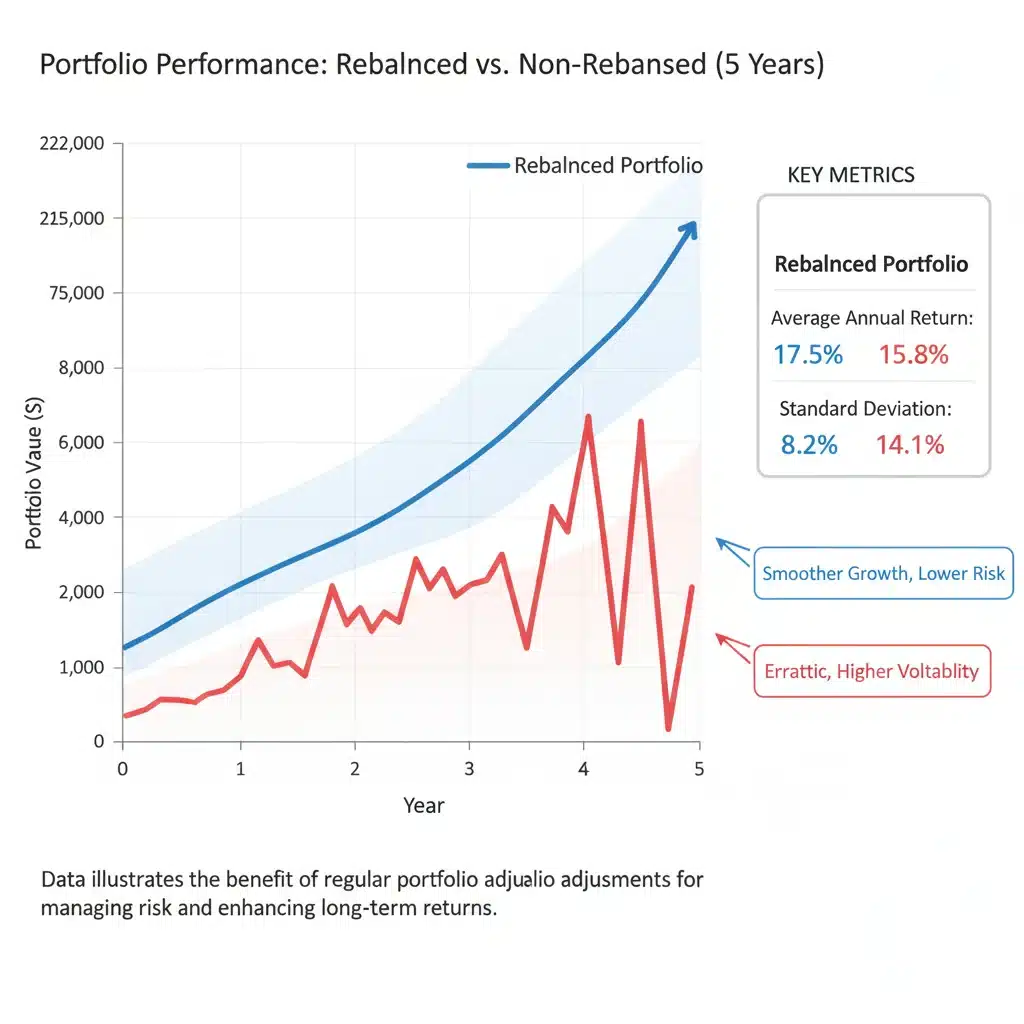
Psychological Benefits and Discipline
Investing can be an emotional rollercoaster. Fear and greed often drive poor decisions. A systematic 3-month portfolio rebalancing strategy removes much of the emotion from investing. It provides a clear, actionable plan that you execute regardless of market sentiment. This discipline is invaluable, preventing impulsive decisions during market highs or lows and helping you stick to your long-term financial goals. It instills good habits and fosters a consistent approach to wealth building.
In summary, a 3-month portfolio rebalancing strategy is more than just an administrative task; it’s a sophisticated technique that enhances risk management, capitalizes on market movements, improves diversification, potentially boosts long-term returns, and instills crucial investment discipline. For 2026 and beyond, it’s an indispensable component of a well-managed investment portfolio.
Implementing Your 3-Month Portfolio Rebalancing Strategy
Now that we understand the ‘why,’ let’s delve into the ‘how.’ Implementing a 3-month portfolio rebalancing strategy is a methodical process that requires careful planning and execution. Here are the practical steps to get you started and keep you on track for 2026:
Step 1: Define Your Target Asset Allocation
Before you can rebalance, you need something to rebalance to. This is your target asset allocation – the ideal mix of different asset classes (e.g., stocks, bonds, real estate, commodities) that aligns with your financial goals, time horizon, and risk tolerance. This initial allocation is critical. For example, a younger investor with a long time horizon might opt for a more aggressive 80% stocks/20% bonds, while someone nearing retirement might choose a more conservative 40% stocks/60% bonds. If you haven’t done this, now is the time. Consider consulting a financial advisor to help you establish appropriate targets.
Step 2: Choose Your Rebalancing Dates
For a 3-month portfolio rebalancing strategy, you’ll need to pick four dates throughout the year. These should be consistent. Common choices are the end of each quarter: March 31st, June 30th, September 30th, and December 31st. Marking these dates on your calendar or setting up automated reminders is crucial for maintaining discipline. Consistency is key to the success of this time-based strategy.
Step 3: Review Your Current Asset Allocation
On your chosen rebalancing date, the first step is to assess your current portfolio. Calculate the actual percentage of each asset class in your portfolio. Most brokerage accounts and investment platforms provide tools or reports that make this calculation relatively straightforward. Compare these actual percentages to your target percentages defined in Step 1. This will clearly show which asset classes are overweighted and which are underweighted.
Step 4: Execute the Rebalance
This is where the actual buying and selling happens. The goal is to bring your actual asset allocation back in line with your target. There are a few ways to do this:
- Selling and Buying: This is the most direct method. Sell portions of your overperforming, overweighted assets and use the proceeds to buy more of your underperforming, underweighted assets. Be mindful of potential capital gains taxes when selling, especially in taxable accounts.
- Using New Contributions: If you regularly contribute new money to your investments (e.g., through monthly savings), you can direct these new funds towards the underweighted asset classes. This can often reduce the need for selling, thereby minimizing transaction costs and potential tax implications. This is a highly efficient way to rebalance, especially for growing portfolios.
- Dividend Reinvestment: Similarly, you can direct dividends and interest payments from your investments to flow into underweighted asset classes.
The extent of your rebalancing depends on the deviation. Some investors prefer to only rebalance if an asset class deviates by more than a certain threshold (e.g., 5% or 10%) from its target, even within a time-based schedule. However, for a strict 3-month portfolio rebalancing strategy, the aim is usually to bring it as close to the target as practically possible, considering transaction costs.
Step 5: Document and Learn
After each rebalancing, make a note of the changes you made and the reasons behind them. Over time, this documentation can provide valuable insights into market behavior and your own investment decisions. It also serves as a record for tax purposes. While the strategy is systematic, periodically reviewing your overall financial plan (perhaps annually) to ensure your target asset allocation still aligns with your life circumstances is also a good practice.
By following these practical steps, your 3-month portfolio rebalancing strategy will become a seamless and powerful component of your investment routine, setting you up for success in 2026 and beyond.
Advanced Considerations for Your Portfolio Rebalancing Strategy
While the basic 3-month portfolio rebalancing strategy is effective, there are several advanced techniques and considerations that can further refine your approach. These are particularly relevant for investors with larger portfolios, specific tax situations, or those seeking an even more nuanced control over their investments as we head into 2026.
Tax-Loss Harvesting
For investors in taxable accounts, tax-loss harvesting can be a powerful complement to your portfolio rebalancing strategy. When you rebalance, you might identify assets that have lost value. Selling these losing assets can generate capital losses, which can then be used to offset capital gains and, to a limited extent, ordinary income. This strategy can reduce your overall tax bill. However, be mindful of the ‘wash sale’ rule, which prevents you from buying a substantially identical security within 30 days before or after selling it for a loss. Integrating tax-loss harvesting into your rebalancing process requires careful timing and understanding of tax regulations.
Location of Assets (Tax-Efficient Placement)
Another advanced technique is strategic asset location. This involves deciding which types of assets to hold in which types of accounts (e.g., taxable brokerage accounts, IRAs, 401(k)s). Generally, assets expected to generate high ordinary income (like bonds or REITs) or frequently traded assets are often better placed in tax-advantaged accounts to defer or avoid taxes. Assets with lower turnover or qualified dividends might be suitable for taxable accounts. When rebalancing, consider how your adjustments impact the tax efficiency of your entire portfolio across all account types. This can be complex, and professional advice is often beneficial.
Rebalancing Bands vs. Strict Intervals
While our focus is on a time-based 3-month portfolio rebalancing strategy, some investors combine this with rebalancing bands. This means you only rebalance at the 3-month mark if an asset class has deviated by a certain percentage (e.g., 5% or 10%) from its target. If the deviation is minimal, you might choose to forgo rebalancing for that quarter to save on transaction costs. This hybrid approach offers flexibility, reducing unnecessary trading while still ensuring your portfolio doesn’t drift too far off course. The optimal band width depends on your risk tolerance and the volatility of your assets.
Consideration of Transaction Costs
Even with commission-free trading becoming more common, transaction costs can still impact your returns, especially with frequent rebalancing. These costs can include bid-ask spreads, expense ratios of funds, and potential capital gains taxes. When implementing your 3-month portfolio rebalancing strategy, be mindful of these costs. For smaller deviations, sometimes the cost of rebalancing might outweigh the benefit. Using ETFs or mutual funds with low expense ratios and focusing on new contributions for rebalancing can help mitigate these costs.
Reviewing Your Target Allocation Annually
While the rebalancing itself happens quarterly, it’s wise to conduct an annual review of your overall financial situation and your target asset allocation. Life events (marriage, children, job changes, retirement), changes in financial goals, or significant shifts in your risk tolerance should prompt a re-evaluation of your ideal portfolio mix. Your 3-month rebalancing strategy keeps you aligned with your current target, but an annual review ensures that target remains appropriate for your evolving circumstances in 2026 and beyond.

Automated Rebalancing Tools
Many robo-advisors and some brokerage platforms now offer automated rebalancing services. If you find manual rebalancing tedious or worry about sticking to the discipline, these tools can be incredibly useful. They can automatically adjust your portfolio back to its target allocations at pre-set intervals or when certain thresholds are breached. This automation ensures consistency and removes the emotional element entirely, making your 3-month portfolio rebalancing strategy effortless.
By incorporating these advanced considerations, you can transform your 3-month portfolio rebalancing strategy from a basic maintenance task into a sophisticated engine for long-term wealth optimization, tailored to your unique financial situation and the opportunities of 2026.
Common Pitfalls to Avoid in Your Rebalancing Strategy
Even with the best intentions, investors can stumble when implementing a portfolio rebalancing strategy. Being aware of these common pitfalls can help you navigate around them and ensure your 3-month cycle for 2026 remains effective.
1. Over-Rebalancing (Too Frequent or Too Small Deviations)
While a 3-month cycle is generally good, rebalancing too frequently (e.g., monthly or weekly) or rebalancing for very small deviations can lead to excessive transaction costs, especially if you’re paying commissions or if the bid-ask spread is significant. For smaller portfolios, the impact of these costs can eat into your returns. It’s important to find a balance where the benefits of realigning your portfolio outweigh the costs of doing so. The 3-month interval is often a good compromise, but be mindful of the costs if your portfolio is very small or if using high-cost funds.
2. Letting Emotions Dictate Decisions
The primary benefit of a systematic portfolio rebalancing strategy is to remove emotion from investing. However, it’s easy to second-guess the process. When an asset class is soaring, the temptation to let it run and delay selling can be strong. Conversely, when an asset class is plummeting, the fear of buying more can be paralyzing. Sticking to your pre-defined 3-month schedule, regardless of market sentiment, is crucial. Trust the process, as it’s designed to keep you aligned with your long-term goals, not to chase short-term trends.
3. Ignoring Tax Implications
For investments held in taxable accounts, selling assets for rebalancing can trigger capital gains taxes. Ignoring these implications can significantly reduce your net returns. As discussed in the advanced techniques section, consider strategies like tax-loss harvesting or using new contributions to rebalance. If you have significant gains, consult with a tax professional to understand the best approach to minimize your tax burden while still achieving your rebalancing goals.
4. Not Reviewing Your Target Allocation Annually
While your 3-month portfolio rebalancing strategy keeps your portfolio aligned with its target, that target itself isn’t set in stone forever. Life changes – career shifts, marriage, children, buying a home, approaching retirement – all impact your financial goals and risk tolerance. Failing to review and potentially adjust your target asset allocation annually means you might be perfectly rebalancing to a goal that no longer serves you. Make an annual check-up of your overall financial plan a priority.
5. Focusing Only on Returns, Not Risk
Some investors view rebalancing purely through the lens of maximizing returns. While it can enhance risk-adjusted returns, its primary purpose is risk management. If you only look at which assets have performed best and resist trimming them, you’re missing the point. The goal is to maintain your desired risk profile. Letting an overperforming asset grow unbounded increases your concentration risk and can lead to larger losses during a downturn. A 3-month portfolio rebalancing strategy is as much about managing downside risk as it is about capturing upside potential.
6. Complexity and Lack of Automation
For larger or more complex portfolios, manual rebalancing can become tedious and time-consuming. If the process feels like a burden, you might be tempted to skip it, which defeats the purpose. Consider leveraging automated tools offered by robo-advisors or brokerage platforms to streamline the process. Automation ensures consistency and reduces the chances of human error or procrastination.
By being mindful of these common pitfalls, you can ensure your 3-month portfolio rebalancing strategy remains a powerful and effective tool for optimizing your investments in 2026 and for many years to come.
Conclusion: Your Path to an Optimized Portfolio in 2026
As we’ve explored, a disciplined 3-month portfolio rebalancing strategy is not merely a suggestion; it’s a fundamental pillar of sound investment management. In an increasingly interconnected and often unpredictable global economy, such a systematic approach becomes an indispensable tool for investors aiming to navigate the complexities of 2026 and beyond.
We began by understanding that rebalancing is the vital act of realigning your investment portfolio to its initial, desired asset allocation. This process, far from being a passive chore, is an active defense against the natural drift that occurs as different asset classes perform unevenly. Choosing a 3-month cycle for this portfolio rebalancing strategy offers a crucial balance, providing enough frequency to adapt to market shifts without being overly burdensome or costly. It ensures that your risk exposure remains consistent, prevents overconcentration in any single area, and systematically encourages the ‘buy low, sell high’ principle.
The benefits are clear: from enhanced risk management and improved diversification to the potential for superior long-term, risk-adjusted returns, a quarterly rebalancing schedule instills discipline and removes the emotional pitfalls that often derail investor success. By following the practical steps outlined – defining your target allocation, setting clear rebalancing dates, reviewing your current portfolio, and executing the necessary trades (or using new contributions) – you can demystify the process and make it a seamless part of your financial routine.
Furthermore, by considering advanced techniques such as tax-loss harvesting, strategic asset location, and understanding the role of rebalancing bands, you can tailor your portfolio rebalancing strategy to your unique financial situation, maximizing efficiency and minimizing costs. And by being vigilant against common pitfalls like emotional trading, ignoring tax implications, or failing to review your overall target allocation annually, you can safeguard your strategy’s effectiveness.
Ultimately, your investment journey is a marathon, not a sprint. The consistent application of a 3-month portfolio rebalancing strategy acts as your regular tune-up, ensuring your financial engine runs smoothly, efficiently, and in alignment with your long-term destination. It empowers you to maintain control, adapt to change, and confidently pursue your financial aspirations. Embrace this strategy, and position your portfolio for optimal performance and resilience in 2026 and for the many years of growth that lie ahead.
Take control of your financial future. Start implementing your 3-month portfolio rebalancing strategy today and build a robust, optimized portfolio ready for whatever the market brings.