2026 Social Security Adjustments: What Beneficiaries Need to Know About the 3.2% Increase

Anúncios
Understanding the 2026 Social Security Adjustments: What Beneficiaries Need to Know for a 3.2% Increase
As we look ahead, one of the most critical financial topics for millions of Americans is the future of Social Security benefits. For those currently receiving benefits, and for those planning to in the near future, understanding the annual adjustments is paramount. The year 2026 is already generating significant discussion, particularly concerning the projected Cost-of-Living Adjustment (COLA). Early projections indicate a potential 3.2% increase, a figure that, while subject to change, offers a vital glimpse into the financial landscape for beneficiaries. This comprehensive guide delves into the nuances of the 2026 Social Security adjustments, explaining what a 3.2% increase could mean for your wallet, the factors influencing these changes, and how you can best prepare.
Anúncios
The Core of Social Security: COLA Explained
At the heart of the annual Social Security adjustments lies the Cost-of-Living Adjustment, or COLA. This mechanism is designed to ensure that the purchasing power of Social Security benefits is not eroded by inflation. Essentially, as the cost of goods and services rises, COLA aims to increase benefit payments proportionally, allowing beneficiaries to maintain their standard of living. Without COLA, the fixed income of retirees, disabled individuals, and survivors would steadily lose value over time, creating significant financial hardship.
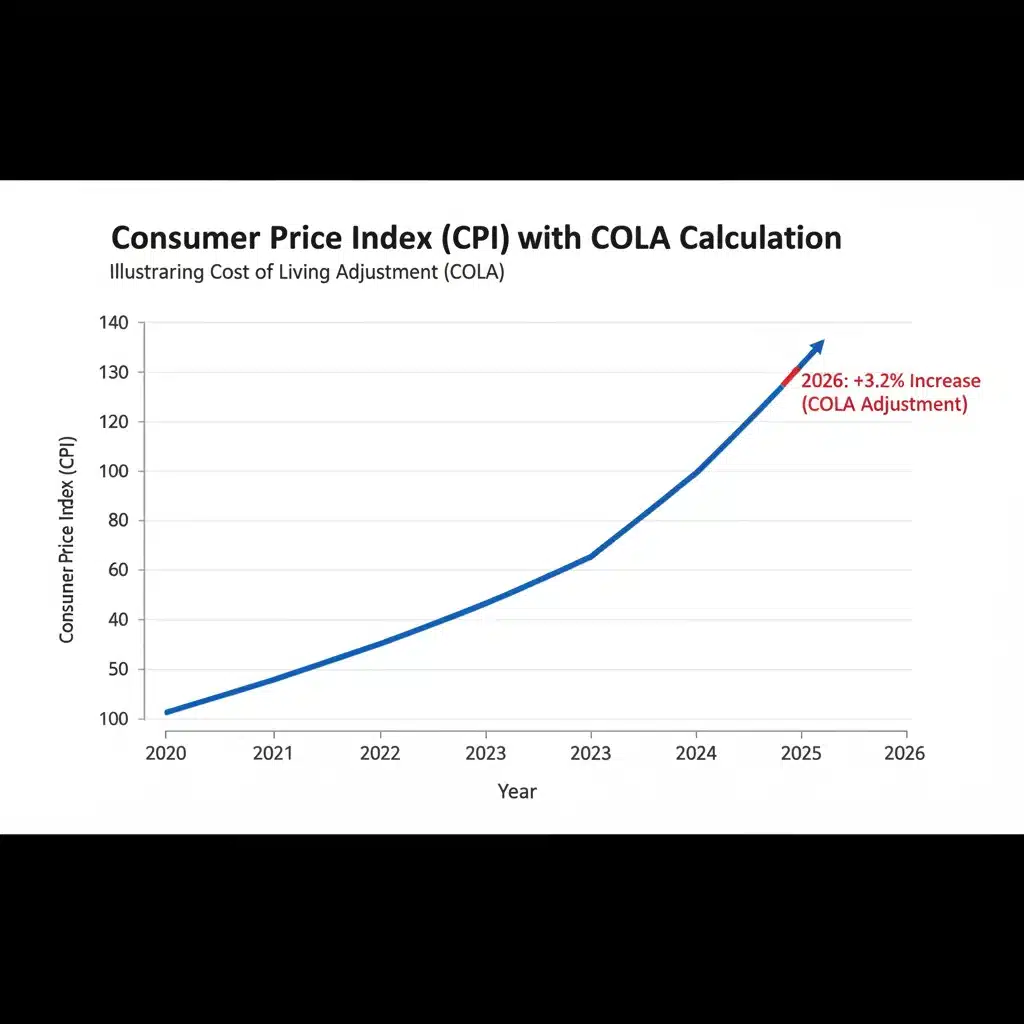
The calculation of COLA is tied to the Consumer Price Index for Urban Wage Earners and Clerical Workers (CPI-W). Specifically, the Social Security Administration (SSA) compares the average CPI-W for the third quarter (July, August, and September) of the current year with the average for the same period of the previous year. The percentage increase, if any, determines the COLA for the following year. If there is no increase, or if the CPI-W decreases, there is no COLA for that year. However, Social Security benefits never decrease due to a COLA calculation; they can only remain the same or increase.
Understanding this process is crucial because it directly impacts the projected 3.2% increase for 2026. This projection is not a guarantee but rather an informed estimate based on current economic trends and inflation forecasts. The official announcement for the 2026 COLA will typically come in October 2025, after the relevant CPI-W data has been compiled and analyzed.
Anúncios
For many, Social Security benefits represent a significant, if not primary, source of income. Therefore, any adjustment, big or small, has a tangible effect on daily living expenses, budgeting, and overall financial security. The 2026 Social Security Adjustment, with its projected 3.2% increase, signals a continued effort to keep pace with economic realities.
What a 3.2% Increase Means for Your Benefits
A 3.2% increase in Social Security benefits, while seemingly modest, can translate into a meaningful boost for beneficiaries. To illustrate, let’s consider a few scenarios:
- Average Beneficiary: If the average monthly Social Security benefit for a retired worker is, for example, $1,900 in 2025, a 3.2% COLA would add approximately $60.80 to their monthly check, bringing it to $1,960.80. Over a year, this amounts to an additional $729.60.
- Higher Beneficiary: For someone receiving a higher monthly benefit, say $3,000, a 3.2% increase would mean an extra $96 per month, totaling $3,096. Annually, this would be an additional $1,152.
- Lower Beneficiary: Even for those receiving a lower benefit, for instance, $1,200 per month, a 3.2% increase would add $38.40, resulting in a new monthly benefit of $1,238.40. This would provide an extra $460.80 over the year.
These examples highlight that while the percentage is uniform, the actual dollar amount gained varies based on an individual’s current benefit level. It’s important to remember that these are illustrative figures. Your actual benefit amount will depend on your earnings history and the specific rules applied to your claim.
Beyond the direct increase in benefit payments, a COLA also impacts other aspects of Social Security. For instance, the maximum amount of earnings subject to Social Security taxes (the ‘taxable maximum’) typically increases each year, often in line with wage growth. While not directly tied to COLA, these adjustments are part of the broader economic factors influencing the system. Similarly, the earnings test limits for those receiving benefits before full retirement age also tend to adjust upwards, allowing individuals to earn more without their benefits being temporarily reduced.
Factors Influencing the 2026 Social Security Adjustment
The projection of a 3.2% COLA for 2026 is not pulled out of thin air. It’s the result of analyzing several key economic indicators and trends. The primary driver, as mentioned, is the CPI-W. However, broader economic forces contribute to the movement of this index.
Inflationary Pressures
The most significant factor is inflation. If the cost of living, particularly for goods and services commonly consumed by urban wage earners and clerical workers, continues to rise, then a higher COLA is more likely. Factors contributing to inflation can include:
- Energy Prices: Fluctuations in oil and gas prices directly impact transportation costs and, indirectly, the cost of almost all goods.
- Food Costs: Agricultural yields, supply chain issues, and global demand can significantly affect food prices.
- Housing Costs: Rent and homeownership expenses are major components of household budgets and thus influence inflation.
- Supply Chain Dynamics: Disruptions or improvements in global supply chains can either push prices up or help stabilize them.
- Wage Growth: Strong wage growth can contribute to increased consumer demand, which in turn can fuel inflation.
Economic forecasts for the period leading up to the COLA calculation in Q3 2025 play a crucial role. If economists anticipate continued moderate inflation, the 3.2% projection could hold firm. Conversely, unexpected shifts in the economy could alter this outlook.
Economic Growth and Stability
The overall health of the economy also plays a role. A robust economy with low unemployment typically leads to higher wages and increased consumer spending, which can contribute to inflationary pressures. Conversely, an economic downturn could lead to lower inflation or even deflation, potentially resulting in a smaller or no COLA.
Global Events
Geopolitical events, international trade policies, and global supply disruptions can all have ripple effects on the U.S. economy and, by extension, inflation. For example, conflicts or natural disasters in key resource-producing regions can drive up commodity prices globally.
It’s a complex interplay of these factors that ultimately determines the final COLA figure. The 3.2% projection for the 2026 Social Security Adjustment reflects a current understanding of these dynamics, but beneficiaries should remain aware that these are subject to change until the official announcement.

Who Benefits from the 2026 Social Security Adjustment?
The COLA increase applies to all Social Security beneficiaries. This includes:
- Retired Workers: The largest group of beneficiaries, receiving payments based on their earnings history.
- Spouses of Retired or Deceased Workers: Individuals who receive benefits based on their spouse’s or former spouse’s work record.
- Survivors: Widows, widowers, and minor children of deceased workers.
- Disabled Workers: Individuals receiving Social Security Disability Insurance (SSDI) benefits.
- Supplemental Security Income (SSI) Recipients: While SSI is a separate program from Social Security, SSI benefits are also adjusted annually based on the same COLA percentage.
Essentially, if you are receiving any form of Social Security benefit, your payments will be adjusted by the announced COLA. This broad impact underscores the importance of the 2026 Social Security Adjustment for a vast segment of the American population.
Preparing for the 2026 Social Security Adjustment
While the official COLA announcement is still some time away, proactive planning can help beneficiaries make the most of the anticipated 3.2% increase. Here are some strategies:
Review Your Budget
Even a modest increase can provide a bit more breathing room in your budget. Take the time to review your current income and expenses. If the 3.2% increase materializes, consider how that extra income could be utilized. Could it cover rising healthcare costs? Contribute to a savings goal? Or simply provide a buffer against unexpected expenses?
Consider Healthcare Costs
It’s essential to remember that while Social Security benefits increase, so too can the costs of other necessities, particularly healthcare. Medicare Part B premiums are often deducted directly from Social Security checks, and these premiums can also increase annually. While the ‘hold harmless’ provision protects many beneficiaries from a decrease in their net Social Security payment if Medicare premiums rise significantly, it’s still wise to factor potential healthcare cost increases into your financial planning.
Stay Informed
Keep an eye on economic news and official announcements from the Social Security Administration. While projections like the 3.2% for the 2026 Social Security Adjustment are helpful, the final figure can vary. Subscribing to updates from reliable financial news sources or the SSA directly can ensure you have the most accurate and up-to-date information.
Consult a Financial Advisor
For personalized guidance, especially if you have complex financial situations or are nearing retirement, consulting a financial advisor can be invaluable. They can help you integrate your Social Security benefits into a broader retirement plan, offering advice on investment strategies, tax implications, and long-term financial security.
The Broader Implications: Social Security’s Long-Term Outlook
While the annual COLA is crucial for current beneficiaries, it’s also important to consider the long-term solvency of the Social Security system. Debates about the future of Social Security are ongoing, with discussions centered on funding mechanisms, demographic shifts, and potential reforms.
The annual Trustees’ Report provides a detailed analysis of the financial state of Social Security. These reports typically project that without legislative changes, the trust funds may be able to pay only a portion of scheduled benefits in the coming decades. This is primarily due to demographic shifts, such as lower birth rates, increased life expectancy, and the retirement of the baby boomer generation, which means fewer workers are contributing per beneficiary.
However, it’s important to differentiate between the annual COLA adjustments and the long-term solvency challenges. The COLA mechanism is designed to adjust benefits based on inflation, ensuring current beneficiaries’ purchasing power. The solvency issues are about the system’s ability to pay *any* benefits at current levels in the distant future.
Policymakers continue to explore various options to strengthen Social Security, including:
- Raising the Full Retirement Age: Gradually increasing the age at which individuals can receive full retirement benefits.
- Adjusting the Taxable Maximum: Increasing the amount of earnings subject to Social Security taxes.
- Modifying the COLA Formula: Exploring alternative inflation measures that might result in smaller annual increases.
- Increasing the Social Security Tax Rate: A direct increase in the percentage of earnings workers and employers contribute to the system.
- Means-Testing Benefits: Reducing benefits for higher-income retirees.
These are complex issues with significant political and economic implications. While the 2026 Social Security Adjustment focuses on immediate benefit changes, beneficiaries and future retirees should stay informed about these broader discussions, as they could impact the long-term structure and generosity of the program.
Historical Context of COLA Adjustments
To put the projected 3.2% increase for the 2026 Social Security Adjustment into perspective, it’s helpful to look at historical COLA figures. Over the past few decades, COLA amounts have varied significantly, reflecting different economic environments:
- In the late 1970s and early 1980s, COLA increases were in the double digits due to extremely high inflation.
- In more recent years, COLA has often been much lower, sometimes even zero in years with very low or no inflation (e.g., 2010, 2011, 2016).
- The COLA for 2022 was 5.9%, and for 2023 was a substantial 8.7%, reflecting significant inflation post-pandemic. The 2024 COLA was 3.2%, and the 2025 COLA is projected to be 2.6%.
The projected 3.2% for 2026, if it holds, would be consistent with a trend of moderate but consistent adjustments, following the higher inflation years of the early 2020s. This historical context underscores the dynamic nature of COLA and its direct link to the economic climate.
Navigating Potential Challenges and Opportunities
For many, Social Security benefits are a lifeline. The 2026 Social Security Adjustment, with its projected 3.2% increase, presents both challenges and opportunities. The primary challenge remains ensuring that the increase adequately covers the rising cost of living, especially for essential expenses like food, housing, and healthcare. While a 3.2% increase is positive, individual spending patterns and regional cost differences mean its impact will vary.
The opportunity lies in using this increase strategically. For some, it might mean the ability to save a little extra, pay down debt, or address deferred maintenance on their homes. For others, it might simply mean maintaining their current standard of living without having to cut back due to inflation. Understanding your personal financial situation and how this adjustment fits into your overall plan is key.
Conclusion: Staying Ahead of the Curve
The 2026 Social Security Adjustment is a critical development for millions of Americans. The projected 3.2% COLA increase, while not yet official, provides a valuable benchmark for financial planning. By understanding how COLA is calculated, what this increase could mean for your specific benefits, and the broader economic factors at play, beneficiaries can better prepare for the financial year ahead.
Remember to stay informed about official announcements from the Social Security Administration, review your personal budget, and consider seeking professional financial advice if needed. Social Security benefits are a cornerstone of financial security for many, and being proactive in understanding and adapting to annual adjustments like the 2026 Social Security Adjustment is essential for maintaining peace of mind and financial well-being in retirement and beyond.
As the economic landscape continues to evolve, so too will the mechanisms designed to protect the purchasing power of Social Security. Staying informed and planning wisely are your best tools for navigating these changes effectively.